
The Life Extension Table: How to Translate Oil Cleanliness into a Business Case
Steffen Nyman
8 min
18 June 2026
Your oil analysis report can give you an ISO cleanliness code. Using the Life Extension Table, you can compare this number with the recommended ISO code and see the component life improvement you can receive. Here is how to use it to build a financial justification for filtration.
From ISO code to financial impact
An oil analysis report gives you a number: ISO 19/17/14, or ISO 22/20/16, or ISO 16/14/11. Most maintenance engineers know that a lower number is better and a higher number is worse. Fewer know how to translate that number into a financial argument for doing something about it.
The Life Extension Table, made by Noria Corporation, is the tool that makes that translation possible. It takes your current ISO cleanliness code, your target cleanliness (recommended level), and the type of machinery involved, and returns a single number: the factor by which component life is extended when cleanliness improves from current to target.
How to read the Life Extension Table
The table has two axes. The vertical axis shows your current ISO 4406 cleanliness code. The horizontal axis shows your target cleanliness level. The intersection gives the lifetime extension factor. The table is divided into four sections for different machinery types, because sensitivity to particle contamination varies.
The scale is logarithmic: improvements at the lower end of the cleanliness scale yield larger lifetime extension factors. This reflects the physics of abrasive wear - at high contamination levels, the rate of damage is disproportionately high.
Machinery type | Sensitivity to contamination |
|---|---|
Hydraulic and diesel systems (high pressure, servo- and proportional valves, piston pumps) | Very high, ISO 15/13/10 - 16/14/11 is required |
Rolling element bearings | High, ISO 16/14/11 - 17/15/12 is required |
Journal bearings and turbo machinery | High to medium, ISO 16/14/11 - 18/16/13 is required |
Gearboxes | High-medium-low depending on application. From ISO 16/14/11 for high load and long life over 18/16/13 for normal gears to 20/18/15 for very contaminated environments like mining/cement |
LET - Noria Corporation
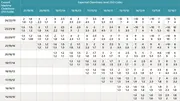
Example 1: Hydraulic system
A hydraulic system running at ISO 22/20/17 is improved to ISO 16/14/11 through offline filtration. The Life Extension Table for hydraulic systems gives a factor of 5. Components that would have needed replacement after 4,000 hours will now last 20,000 hours.
If the hydraulic pump costs €5,000 to replace and labour plus downtime adds €3,000, the saving over 20,000 hours is four replacement events - €32,000 from this single component. If this pump is critical for production and a breakdown causes many hours of downtime, the lost production can easily account for excess of €50,000.
Example 2: Gearbox
The same cleanliness improvement (ISO 22/20/17 to ISO 16/14/11) applied to a gearbox gives a life extension factor of 3.5. The difference reflects the lower sensitivity of gearbox components compared to hydraulic pumps and valves, which have clearances of 1–5 microns and are extremely sensitive to fine particles.
What the table does not capture
The Life Extension Table quantifies component lifetime extension. It does not capture extended oil life (a direct saving when oil change intervals double or triple), reduced unplanned downtime (often the largest single financial benefit), or the CO₂ reduction that follows from fewer component replacements and less oil consumption.
Conclusion
The ISO cleanliness code on your oil analysis report is not just a quality indicator - it is a financial metric. The Life Extension Table translates it into a component lifetime factor, and that factor translates directly into a savings in OPEX including maintenance. For any system where component replacement is a significant cost, the table provides the foundation for a business case grounded in data rather than estimates.
Stay updated with our latest articles
Get new insights, industry knowledge, and updates from C.C.JENSEN directly in your inbox.

From Black to Honey
Watch how CJC® offline filtration progressively restores contaminated oil back to its clean, golden state - protecting your equipment at every stage of the process.
Black, carbon-laden oil - uncountable particles
Heavily Contaminated Oil
In tyre production, oil in Banbury mixer gearboxes quickly becomes saturated with carbon black. These fine particles turn oil pitch black. Particle counts are often described as 'uncountable' by oil analysis laboratories.
At ISO cleanliness code 2217 or worse, the useful oil life is very short, and every rotation of a gear is creating wear - the oil properties are not up to the task and are accelerating degradation.
ISO Code: ≥2217 - Often uncountable
Filtration Begins - First Hours
Within the first 3 hours of connecting a CJC® filter unit, contamination including carbon black begins to be removed. The oil shifts from pure black toward a very dark brown.
At Michelin's Plant 3 in Spartanburg, particle counts dropped from ISO 2216 to 1112 within just 3 hours - a dramatic first improvement demonstrating the filter's immediate impact.
ISO Code: ~2115 - Bulk particles are being captured
Extensive Particle Removal - Days 1–4
Over the first 4 days of continuous operation, carbon black and fine particles below 5 µm - those responsible for most wear - are systematically captured throughout the full depth of the filter media.
Standard in-line filters only capture particles above ~10 µm resulting in gearbox wear and short oil life. CJC® depth filtration removes down to 0.8 µm particles as well as oil degradation products. The oil visibly shifts to a deep dark amber.
ISO Code: ~1114 - Reducing number of fine particles
Water & Varnish Removal - Week 1–2
Beyond particles, moisture and oil degradation products, the precursors to varnish formation, are extracted during continuous operation. Free and dissolved water - present from process steam and ambient humidity - is removed, preventing oil oxidation and increasing acidity.
The oil is now a warm amber color, approaching its natural base color. Wear rates are measurably declining, and equipment is benefitting from cleaner operating conditions.
ISO Code: ~1111 - Water & oxidation removal
Clean, Golden Oil - Target Achieved
With continuous CJC® offline filtration, oil reaches and maintains its target cleanliness level - appearing as the rich honey-golden color it was designed to be. This is oil at its optimum working condition: clean, dry, and free of degradation products.
At this level, gearbox and hydraulic systems operate with measurably lower wear rates. Oil changes become condition-based rather than scheduled. Maintenance shifts from reactive intervention to controlled operation.
ISO Code: ≤1110 - Target cleanliness maintained
