
CJC® T²render™ Condition Monitoring
Online monitoring of oil and equipment condition
Why condition monitoring matters
Changes in oil condition and equipment behaviour often develop gradually - and remain invisible until failures occur. Without continuous monitoring, early warning signs are easily missed.
CJC® T²render™ provides ongoing insight into oil systems by monitoring validated sensor data and identifying deviations from normal operation. This enables earlier intervention, improved reliability, and more informed maintenance decisions.
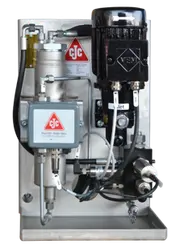
What is condition monitoring?
Condition monitoring uses sensor data to track oil condition and equipment performance over time. Instead of relying solely on periodic inspections or oil sampling, key parameters are monitored continuously.

Detect abnormal oil and equipment conditions early

Reduce unplanned downtime

Optimize oil filtration and oil sampling

Extend oil and component lifetime
CJC® T²render™ turns raw sensor data into clear condition indicators - supporting condition-based maintenance rather than reactive repairs.
How condition monitoring works
How CJC® T²render™ works

Sensors collect data
Sensors are installed on or near the oil system, either individually or as part of a CJC® Condition Monitoring Unit (CMU).

Data is analysed
Sensor data is securely transferred to the CJC® Cloud Solution, where it is validated and analysed.

System condition is evaluated
Depending on solution level, data is assessed against fixed limits or advanced statistical models.

Warnings are issued
When deviations occur, warnings are generated -allowing early action before failures develop.
CJC® T²render™ Basic vs. Pro
T²render™ Basic | Basic vs. Pro | |
|---|---|---|
Energy Consumption
| Monitoring of validated sensor data | Advanced statistical analysis of multiple sensor signals |
Maintenance
| User-defined alarm limits | Converts data into one oil condition value and one equipment condition value |
Waste Generation
| Warnings when limits are exceeded | Early detection of abnormal operating behaviour |
Heating | Supports condition-based oil sampling | Automatic warnings tailored to each individual oil system |
Heating | Optimizes offline oil filtration performance | Reduces need for manual data interpretation |
Proven technology. Measurable performance.
Operational benefits
Earlier detection of abnormal conditions
Improved system reliability and uptime
Better understanding of oil system behaviour
Cost benefits
Reduced unplanned breakdowns
Optimized oil sampling and maintenance
Extended oil and equipment lifetime
How an Oil Filter Works in an Offline Filtration System
Solid Particles and Abrasive Wear:
Solid particles are transported with the oil flow and become trapped between moving metal surfaces. These particles are often similar in size to the clearances inside bearings, pumps, and valves. Once wedged between components, they damage metal surfaces and generate millions of new particles - creating a self-reinforcing wear process.
Oil Degradation and Varnish Formation:
As oil degrades due to heat, pressure, and contamination, oxidation by-products form. These degradation products can dissolve in warm oil but later precipitate as varnish on cooler surfaces. Varnish creates sticky layers that trap particles, forming a sandpaper-like surface that dramatically increases wear and can cause valves to stick or seize.
Water Contamination and Micro-Pitting:
Water is another major threat to oil systems. Even small amounts reduce lubricity and load-carrying capacity. Under high pressure - such as in bearings and gears, water droplets collapse, causing micro-pitting on metal surfaces. Over time, this leads to corrosion, fatigue, and premature component failure.
Part of the Clean Oil approach
CJC® T²render™ works alongside:
Water removal
Removes free and dissolved water from oil to prevent corrosion, cavitation, and premature component failure.
Oxidation and sludge control
Removes oxidation by-products and sludge to keep oil stable, systems clean, and performance predictable.
Acidity reduction
Reduces oil acidity to protect components from corrosion and extend oil and equipment lifetime.
Particle removal
Removes solid contamination from oil to reduce abrasive wear, prevent component damage, and maintain stable system performance.
Together, these elements support long-term system reliability and predictable operation.

Condition monitoring from C.C.JENSEN
Gain continuous insight into oil and equipment condition and act before problems escalate.
