
Offline Oil Filtration
Offline Oil Filtration Explained
Offline oil filtration is one of the most effective ways to maintain clean and dry oil in industrial systems - reducing failures, extending oil lifetime, and protecting critical components.
By continuously removing particles, water, and oil degradation products outside the main oil circuit, offline oil filtration ensures stable oil conditions and significantly lowers the risk of unplanned downtime.

Why Oil Contamination Is a Critical Problem
Oil is constantly exposed to contamination as it circulates through an operating system. Even when new oil is filled under controlled conditions, contamination begins immediately once the system is running.
Research and field experience show that up to 80% of all oil system failures are related to contamination. The most damaging contaminants include:


These contaminants work together to accelerate wear and damage system components long before a failure becomes visible.
How Contamination Damages Oil Systems
Solid Particles and Abrasive Wear:
Solid particles are transported with the oil flow and become trapped between moving metal surfaces. These particles are often similar in size to the clearances inside bearings, pumps, and valves. Once wedged between components, they damage metal surfaces and generate millions of new particles - creating a self-reinforcing wear process.
Oil Degradation and Varnish Formation:
As oil degrades due to heat, pressure, and contamination, oxidation by-products form. These degradation products can dissolve in warm oil but later precipitate as varnish on cooler surfaces. Varnish creates sticky layers that trap particles, forming a sandpaper-like surface that dramatically increases wear and can cause valves to stick or seize.
Water Contamination and Micro-Pitting:
Water is another major threat to oil systems. Even small amounts reduce lubricity and load-carrying capacity. Under high pressure - such as in bearings and gears, water droplets collapse, causing micro-pitting on metal surfaces. Over time, this leads to corrosion, fatigue, and premature component failure.
What Is Offline Oil Filtration?
Offline oil filtration, also known as kidney-loop filtration, works independently from the main oil flow.
Offline oil filtration is a filtration method where oil is continuously cleaned outside the main system flow under stable pressure and flow conditions.
Unlike inline filters that operate under fluctuating pressure and flow,
offline oil filtration works continuously under stable conditions, enabling far more effective contamination control.
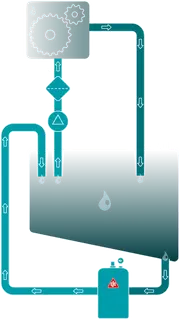
Oil is drawn from the most contaminated point in the system - typically the bottom of the oil tank - and passed through a dedicated filter unit before being returned clean and dry.

Clean Oil Is Not a Recommendation.
It Is a Reliability Strategy.
Understand contamination mechanisms, ISO codes, water control, and how to extend oil and component lifetime.

How an Offline Oil Maintenance System Works
An offline oil maintenance system operates continuously during normal machine operation:
Oil is pumped from the lowest part of the reservoir, where contamination accumulates
The oil passes through a fine filtration insert designed for deep, consistent filtration
Solid particles, water, and oil degradation products are retained in one process
Clean, dry oil is returned to the system
Because filtration happens continuously, contamination is removed as it is generated - preventing damage before it occurs.
Key Benefits of Offline Oil Filtration
Short-Term Benefits
Long-Term Benefits
Reduced overall filtration costs
No shutdown required for filter changes
Reduced maintenance workload
Simple installation and operation
Minimal training required for operators
Extended component lifetime
Longer oil service intervals
Reduced risk of unplanned downtime
Improved system reliability
Lower environmental impact
Why Offline Filtration Outperforms Inline Filtration
Inline filters operate under fluctuating pressure and flow conditions, making it difficult to capture fine particles and retain contamination effectively.
Offline oil filtration, by contrast, runs under constant conditions, allowing the use of dense filter media with high dirt-holding capacity.
This is why offline filtration is considered a best practice in critical and high-value oil systems.
The result is consistently clean oil -regardless of system load or operating cycles.

Clean Oil Means Reliable Machines
Offline oil filtration is not just about cleaner oil - it is about predictable performance, longer asset life, and lower total cost of ownership.
Want to know if offline oil filtration is right for your system?