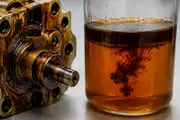
Varnish in Hydraulic Systems: A Six-Month Case Study from TU Munich
Steffen Nyman
9 min
18 June 2026
At the Technical University of Munich, varnish had built up in the servo-hydraulic testing equipment to the point where the MPC value was off the scale. Six months of offline filtration brought it to MPC 3.8. Here is the full recovery timeline.
When a varnish makes a machine unusable
Varnish does not announce itself with high vibrations or a sudden machine stop until it is too late. It accumulates gradually - a thin film on valve spools, cylinder walls, and bearing surfaces - until the clearances for oil, which the system depends on, are no longer there. At the Technical University of Munich, a SCHENK servo-hydraulic testing equipment had reached exactly that point.
The Membrane Patch Colorimetry value, the standard measurement for varnish potential, was so high that it was not measurable. The contamination was off the scale of the Spectro-photometer converting the colour on the membrane patch to the MPC value.
Sluggish and failing hydraulic operation was the result.
What MPC measures and why it matters
In the MPC test, a fixed volume of oil passes through the tiny 0.45-micron pores in the membrane patch made from nitro-cellulose. After drying the patch, a Spectro-photometer is used to convert the colour into the MPC dE value. A value below MPC 15 is considered safe, while above MPC 30 indicates high level of oxidized oil with risk of varnish deposits. Higher MPC values of 40-60 are seen when systems are having large varnish problems, but as the MPC membrane patch catches anything larger than approx. 0.5-micron, dust and wear particles will also give a colour, thus increasing the MPC value. Typically, it is not possible to indicate the MPC value when the level exceeds 100 dE, because contamination blocks the membrane and/or exceeds the instrument's range.
The challenge with varnish is that it is not simply a contamination problem - it is a lubricant degradation problem. The varnish precursors are dissolved in the oil and often referred to as oxidation. These cannot be removed by standard particle filtration e.g. pleated inline filter media. They require a filter media with absorption capabilities - one that attracts and retains the polar oxidation molecules rather than only blocking hard particles by size.
The installation and full recovery in six month
A CJC filter was installed in an offline circuit on the 800-litre oil system tank. The filter ran continuously circulating oil through the cellulose depth filter media, which retained particles and moisture.
As the cellulose has a high specific surface area and strong polar adsorption and absorption properties it also attracted and absorbed the oxidation by-products that form varnish precursors.
Time | MPC value | Particle count (>4 µm) | ISO code (4406) | Water content |
|---|---|---|---|---|
Start | Not measurable | 165,010 | ISO 18/16/11 | 140 ppm |
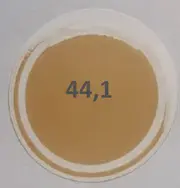
1.5 months | 55.3 | - | - | - |
3 months | 18.5 | - | - | - |
6 months | 3.8 | 4,900 | ISO 13/11/8 | 60 ppm |
After six months of continuous filtration, the MPC value had fallen from unmeasurable to 3.8 - well below MPC 15, which is considered as the safe threshold for risk of varnish deposits.
Particle count larger then 4-micron was reduced from 165,010 to 4,900, giving an impressive ISO code improvement from 18/16/11 to 13/11/8. Water content fell from 140 ppm to 60 ppm. All parameters improved simultaneously using this single filtration unit.
Why the oil was not replaced
The conventional response to highly contaminated oil is a complete oil change - drain and refill. This approach has several drawbacks. It is expensive (purchasing and disposal cost for the synthetic hydraulic oil), and it is not guaranteed to solve the problem, because varnish deposits on all internal machine surfaces are not removed by draining the oil.
Furthermore, it does not address the root cause: the oxidation conditions that produced the varnish in the first place will continue to operate on the new oil, especially since used oil is a severe catalyst for degrading new oil, and it is very difficult to drain 100 percent of the oil from a hydraulic system.
Conclusion
Varnish issues causing sluggish and poor hydraulic operation can be solved. The TU Munich case demonstrates that even highly contaminated oil with MPC values exceeding the measurement range can be brought to a stable, low-varnish condition through continuous offline filtration. This can be done without draining and replacing the oil nor stopping the machine.
Continuous filtration addresses the root cause by removing oxidation by-products as they form and preventing them from reaching the concentration at which they precipitate out as varnish causing system failures.
Stay updated with our latest articles
Get new insights, industry knowledge, and updates from C.C.JENSEN directly in your inbox.

