Understanding Oil Degradation: The Facts about Oxidation, Sludge, and Varnish
Steffen D. Nyman
10 min
25 February 2026
Oil does not last forever. Heat, oxygen, water and metal catalysts drive a chain of chemical reactions that progressively degrade lubricant properties - producing sludge and varnish that clog systems and cause failures. This article discuss the facts and what you can do about it.
The Oxidation Chain Reaction
Oil oxidation is not a single reaction - it is an autocatalytic chain process that, once initiated, accelerates over time. The process begins when heat and oxygen react with hydrocarbon molecules in the oil to form free radicals - highly reactive molecular fragments that attack other oil molecules, generating more free radicals in a self-perpetuating cycle.
The primary drivers of oxidation rate are temperature, oxygen availability, and the presence of catalysts such as water and wear metals (particularly copper and iron). The Arrhenius rule of thumb - that reaction rate doubles for every 10°C (18°F) rise in temperature - applies broadly to oil oxidation. A system running at 70°C will oxidise its oil roughly twice as fast as one running at 60°C.
From Oxidation to Varnish
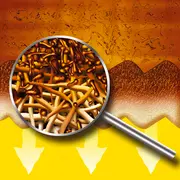
The intermediate products of oxidation - hydroperoxides, aldehydes, and ketones - are polar molecules that are attracted to metal surfaces and to each other. As oxidation progresses, these molecules polymerise and condense into larger, heavier compounds referred to as sludge, which may still be soluble and floating around in the oil.
When the oil cools, typically below operating temperature (40°C / 100°F), these compounds can exceed the oil's solubility limit and precipitate out as varnish - accumulating in low-flow areas of the system: reservoir bottoms, valve housings, heat exchanger passages, and oil cooler tubes.
Varnish is problematic for several reasons. It insulates bearing and heat exchanger surfaces, reducing cooling efficiency and further accelerating oil oxidation. It blocks small orifices and control passages causing valve stiction or fail to start scenarios. Oil oxidation also creates acidic compounds that continue to attack metal surfaces and degrade the oil's additive package. Ester-based lubricants are especially prone to generating acidity when degrading.
Varnish: The Slowly-building Threat
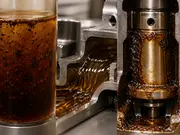
Varnish is a distinct variation of sludge and oil oxidation, though they coexist. Where the dissolved sludge is soft and mobile, varnish is a sticky or hard deposit that adheres to metal surfaces. It is particularly prevalent in turbine oils, compressor oils, and other highly refined mineral oils operating at elevated temperatures. Varnish can cure into a hard lacquer-like deposit sometime seen on cylinder liners in diesel engines.
The industry standard for measuring varnish potential is oxidation by FT-IR or Membrane Patch Colorimetry (MPC) - a test giving results in a delta E (ΔE) value for an oil sample. Values above 15 indicate significant varnish potential; values above 35 indicate critical levels requiring immediate action. MPC test should only be used on fairly clean oils, as the membrane pore size is 0.45-micron, meaning particles will give a false high varnish rating.
Varnish deposits as thin as 1–2 microns on valve spools can cause stiction - a condition where the valve spool sticks in position, causing erratic control behaviour or complete loss of function like fail to start a turbine.
Managing Oxidation: Monitoring and Filtration
Effective management of oil oxidation requires a combination of proactive monitoring and targeted filtration. Key monitoring parameters include Acid Number (AN/TAN), viscosity, oxidation by FT-IR or MPC (ΔE). For large oil systems a RPVOT (Rotating Pressure Vessel Oxidation Test) is often done yearly to estimate the remaining useful oil life.
From a filtration perspective, cellulose-based depth filter media using polar fibers is particularly effective at removing varnish and precursors before they deposit on surfaces.
Other methods are available in the market, such as variations of technologies using electrostatic forces or absorbing beads (ESP, ion exchange media or Fuller’s Earth).
Some users like to keep the varnish dissolved in the oil by adding additives or an ester-based “booster”. This may help to avoid varnish precipitation but is mainly intended for postponing an oil change until the machine can be stopped.
Stay updated with our latest articles
Get new insights, industry knowledge, and updates from C.C.JENSEN directly in your inbox.

