
Critical Varnish Reduced by 85% on a 12 MW Turbo Compressor
CJC reduced varnish potential from a critical 30.4 to a clean 4.7 in just 34 days, while keeping the 12 MW turbo compressor online.
Case study written by: Cille Steffensen Suhr
Application Snapshot

Industry:
Industry

Oil type:
Mineral turbine oil, ISO VG 46 (4,500 L reservoir)
Executive Summary
At an industrial gas production plant in France, oil analysis identified critical varnish potential in the lubrication system of a 12 MW turbocompressor. The system contained approximately 4,500 litres of oil, with an MPC value of 30.4 and an ISO 4406 cleanliness code of 20/15/12.
In a production environment built around the separation and liquefaction of atmospheric air, reliable compression is essential. Varnish potential and elevated particle counts therefore raised concerns about the condition of the oil supporting the machine.
A CJC Varnish Removal Unit was installed to remove contamination from the existing oil. After approximately 820 hours of filtration, equivalent to 34 days, the MPC value had fallen to 4.7, a reduction of approximately 85%. Oil cleanliness improved from ISO 20/15/12 to ISO 17/14/11.

Critical varnish reduced by 85%
Varnish potential (MPC) fell from a critical 30.4 to a clean 4.7 in just 34 days.

4,500 L oil replacement avoided
The existing turbine oil was restored to clean condition by offline filtration, avoiding the cost and disruption of an oil change.

Particle levels reduced by 91%
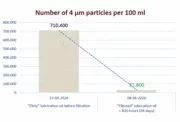
Particles larger than 4 µm dropped from 710,400 to 64,020 per 100 ml, improving the ISO 4406 code from 20/15/12 to 17/14/11.

Critical compressor kept online
The 12 MW turbo compressor remained in operation throughout the treatment, with no shutdown or oil drain required.

Treatment and oil analysis
In 34 days, and after only about 8 turnovers of the oil volume, the oil went from a critical varnish level to clean.
Varnish potential (MPC) fell from 30.4 (critical) to 4.7, a reduction of about 85%. Particles larger than 4 µm dropped by about 91% (710,400 → 64,020 per 100 ml), and the ISO 4406 code improved from 20/15/12 to 17/14/11. Water content, viscosity, and wear metals stayed normal, so the oil base properties were unaffected.
The independent laboratory assessment changed from "particle counts slightly high" to "no apparent anomaly, routine maintenance". The customer avoided replacing about 4,500 L of oil and kept a critical 12 MW machine online while the oil was cleaned.
Customer Benefits
- Financial: The customer avoided replacing about 4,500 L of turbine oil, along with the related costs of new oil, used-oil disposal, flushing and labour. The oil was restored to clean condition by offline filtration instead.
- Operational: Varnish potential fell from a critical 30.4 to a clean 4.7, and particle counts dropped by about 91%, all while the 12 MW compressor was running.
- Environmental: Extending the life of the existing oil means less waste oil to dispose of and less new oil to produce and transport.
Let our experts help you
Get a tailored assessment of your oil condition
and keep your equipment running reliably
