
The Science of Depth Filtration: Why It Outperforms other Filters for Fine Particle Removal
Steffen D. Nyman
7 min
18 March 2026
Surface filters capture particles on a membrane often made of metal. Depth filters capture them throughout a thick, tortuous matrix - and that difference is what makes depth filtration the technology of choice for achieving good cleanliness codes required by modern industrial systems.
Two Fundamentally Different Capture Mechanisms
All filters capture particles by one of two mechanisms: surface capture or depth capture. Understanding the difference is essential to selecting the right filter for your application.
Surface filtration works like a sieve. The filter has a defined pore size, and particles larger than that pore size are captured on the surface of the medium. This approach is highly predictable and provides an absolute cut-off - no particle above the rated size can pass through.
However, as particles accumulate on the surface, they form a cake that rapidly increases differential pressure, requiring frequent element cleaning or back-flushing.
Depth filtration works through a fundamentally different mechanism. The filter medium is a thick, three-dimensional matrix of fibres with a highly tortuous pore structure. Particles are captured throughout the depth of the medium by a combination of filtration – particles larger than the pore size and - most importantly for fine particles - diffusion and polar attraction. This means polar depth filters like some cellulose media, can capture particles significantly smaller than their nominal pore size.
The Dirt-Holding Advantage
The three-dimensional capture mechanism of depth filtration provides a substantial advantage in dirt-holding capacity. Because particles are distributed throughout the volume of the medium rather than accumulating on a surface, depth filters can hold far more contaminant before reaching their differential pressure limit. This translates directly to longer service intervals and lower maintenance costs. The thicker the media, the larger the dirt holding capacity and efficiency for capturing small particles.
For inline pressure filter use the limit of the depth is often given by the accepted pressure loss, meaning most inline filters consist of maximum 1 mm thick media.
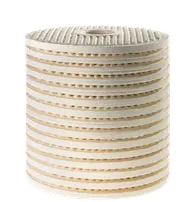
The individual discs in CJC cellulose depth filter inserts are approx. 6 mm thick, resulting in a very large dirt holding capacity per insert - typically 4-10 kg of contaminant in real-world mining and industrial applications - compared to often below 200 grams for a comparable pleated depth filters made of thin membranes. In heavily contaminated systems, this difference can mean the difference between daily or monthly element changes.
Cellulose vs. Synthetic Depth Media
The two most common materials for depth filter media are cellulose (wood pulp) and synthetic fibres (polyester, glass fibre). Cellulose has a specific surface area of approximately 120 m²/gram - roughly 12 times greater than synthetic glass fibre media at around 10 m²/gram.
A single CJC B27/27 insert contains approximately 432,000 m² of active internal area - equivalent to around 60 football/soccer fields - providing exceptional contact between oil and media.
Property | Cellulose Media | Synthetic Media |
|---|---|---|
Specific surface area | ~120 m²/gram | ~10 m²/gram |
Water absorption | High - removes water (up to 2 L typical) | No |
Dirt-holding capacity | Very high (4–10+ kg) | Moderate (<200 g) |
Varnish removal | Yes - via polar attraction | Limited to none |
Natural anti-oxidation | Yes - natural phenols slow oxidation | No |
Optimum usage | Offline oil polishing not inline pressure filtration | Inline pressure filtration not offline oil polishing |
Cost per kg of contamination removed | Low | Higher |
Why Cellulose Depth Filtration Fits Oil Polishing
For most oil applications, cellulose-based depth filters installed in a continuously operating offline loop offer an excellent combination of filtration efficiency, water absorption capability, and dirt-holding capacity.
CJC cellulose filter inserts will remove oil degradation products and varnish as well, which is a unique feature that separates CJC filters from the competition. CJC cellulose depth filters simultaneously remove fine particles, water, varnish and acidity from oil – addressing four contamination challenges with a single filter.
Stay updated with our latest articles
Get new insights, industry knowledge, and updates from C.C.JENSEN directly in your inbox.

