
Avoided emergency drydock by restoring contaminated thruster oil
Mineral gear oil dehydration on an AQUAMASTER azimuth thruster enabled a harbor tug to remain fully operational until its next scheduled drydock.
Case study written by: Hervé Solle, C.C.JENSEN France
In cooperation with: C.C.JENSEN A/S, Denmark
Application Snapshot

Industry:
Marine

Country:
France

Oil type:
EPONA Z 100 (marine mineral gear oil)
Executive summary
A harbor tug operating in France experienced seawater ingress in its starboard azimuth thruster, contaminating the mineral gear oil with critically high water content and elevated sodium levels. With the next scheduled drydock still six months away, continued operation was at risk.
To restore oil condition without interrupting vessel operation, a CJC® Desorber / Filter Combi Unit D5 was installed. Weekly oil sampling was initiated to monitor oil condition and filtration performance.
Within one week, water content was reduced from 3,904 ppm to 136 ppm. Wear metals and sodium levels were also significantly reduced, extending oil and component lifetime and allowing the vessel to remain operational until its planned technical shutdown.

Rapid water removal
Water reduced from 3,904 ppm to 136 ppm

Reduced wear and component stress
Wear metals (Fe & Cu) significantly reduced

Avoided unplanned costs
Emergency drydock and oil replacement avoided, extending oil and component lifetime by factor 5–6.

Lower environmental footprint
No oil change required, reducing oil consumption and associated CO₂ emissions.

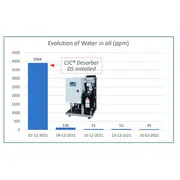
Restoring oil condition without interrupting vessel operation
Oil analysis revealed a water content of 0.39% (3,904 ppm) and sodium contamination of 22 ppm, posing a significant risk to the gearbox and bearings. With drydock still six months away, immediate oil replacement or mechanical intervention was not an option.
The CJC® Desorber D5 was installed and operated continuously. Weekly oil sampling confirmed rapid and stable improvement in oil condition. Within one week, water content was reduced to 136 ppm, well below the recommended maximum of 300 ppm.
In parallel, wear debris levels were reduced. Iron (Fe) decreased from 29 ppm to 17 ppm, copper (Cu) from 4 ppm to 1 ppm, and sodium (Na) from 22 ppm to 13 ppm. The oil was restored to a clean and dry condition, allowing safe continued operation.
Measurable results and operational impact
The filtration solution enabled the vessel to remain fully operational until its next planned technical shutdown, avoiding costly emergency docking and oil replacement.
According to industry reference data, the achieved oil condition corresponds to a lifetime extension factor of 5–6 for both oil and components. The restored oil cleanliness reduced wear, improved reliability, and stabilized maintenance planning.
“The installation of the CJC® Desorber D5 allowed the vessel to remain operational for six months before its next technical shutdown. The results of the analyses clearly demonstrate the effectiveness of the solution.”
– Olivier Gloaguen, Regional Technical Manager
Let our experts help you
Get a tailored assessment of your oil condition
and keep your equipment running reliably
