
Marine thruster dehydration case: avoided emergency drydock
Seawater ingress is a common risk in marine thruster lubrication systems, often leading to rapid oil degradation and unplanned downtime. This marine thruster dehydration case shows how continuous off-line filtration was used to remove water from the lubricating oil, restore oil condition, and avoid an emergency drydock.
Case study written by Christopher Alnor & Sean Pedersen,
C.C.JENSEN A/S, Denmark
Application Snapshot

Industry:
Marine

Oil type:
Main engine lubricating oil (MDO engine)
Executive summary
A drill ship operator sought to reduce the environmental impact and operating costs of its main engine lubrication system while maintaining oil cleanliness within OEM condemning limits. Traditional lubricating oil separators were identified as energy-intensive and operationally demanding.
By replacing the separators with a CJC® Engine Lube Oil Filter operating offline, the vessel significantly reduced energy consumption, oil usage and sludge production. A long-term comparative test confirmed that oil cleanliness was equal to or better than with separators, while delivering substantial operational and environmental benefits.

Energy efficiency
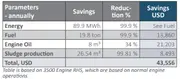
Power consumption for oil filtration reduced by 99.9%, saving 89.9 MWh annually.

Reduced wear and component stress
Oil cleanliness equal to or slightly better than separators, supporting long-term engine protection.

Avoided unplanned costs
Lower OPEX through reduced oil consumption, sludge handling and maintenance effort.

Lower environmental footprint
Reduced fuel use, sludge production and carbon emissions from oil treatment.

Restoring oil condition with lower energy demand
A 1-to-1 performance test was conducted over 4,755 engine running hours, comparing a main engine fitted with a CJC® offline filtration system against one using a traditional separator.
The test demonstrated that the CJC® solution met or exceeded expectations in oil cleanliness while dramatically reducing power consumption, fuel use and waste generation. Pre-heating of oil was no longer required, further improving operational efficiency and safety.
Measurable results and operational impact
The CJC® Engine Lube Oil Filter delivered clear and measurable benefits:
- 99.9% reduction in power consumption, saving 89.9 MWh annually
- 34% reduction in engine oil consumption, saving 8 m³ per year
- 99.81% reduction in sludge production, cutting disposal volumes dramatically
- 19.8 tonnes of fuel saved annually, reducing emissions
- Total annual savings: USD 43,556
Oil cleanliness was maintained at a level similar to or slightly better than the separator, while simplifying maintenance and improving onboard safety.
“Very clean engine when removing crankcase doors and rocker arm covers, no deposits found anywhere.
Easy maintenance, safer operation and power consumption reduced by a factor of 10.”
– Technical Superintendent

Let our experts help you
Get a tailored assessment of your oil condition
and keep your equipment running reliably
